Monday, January 13, 2014

1933: A MAGICAL YEAR IN FILM


The year is 1933. According to astronomers, "one of the first observations suggesting the existence of an invisible dark matter came in 1933 when astronomer Fritz Zwicky noticed that galaxy clusters were more energetic than they should be, according to the mass of visible stars in them, and he proposed dark matter to explain the discrepancy."* Yes, darkness was all around in 1933 but there was indeed an inexplicable surge of energy in the air. This year represented a tremendous pinnacle of news headlines in history, rarely seen before...
-Hitler's rise to power followed by his systematic genocide of millions of Jews and other citizens
-Inauguration of our 32nd President Franklin Delano Roosevelt and his promise to irradicate the Great Depression
-end of Prohibition
-Mt. Rushmore is dedicated
-1st Drive-In theater is opened
-Golden Gate bridge construction commences
-countless federal programs start to stimulate the U.S. economy such as: FDIC, PWA, and National Recovery Act
-Congress passes 1st minimum wage law
-FM radio is patented
-1st airplane to exceed record-breaking 300 mph
-1st solo flight around the world 
-Lou Gehrig breaks baseball record by playing 1,308th consecutive game 
-Albert Einstein arrives in the U.S. as a refugee from Germany

1933 was a year that despite such dark and troubling times, there was also a backlash of incredible hope and creative achievements, unparalleled to any other time in history. This is perfectly reflected in the artistic accomplishments of film. Here is a sampling of some of the best of the best of 1933...

KING KONG (1933):
Merian C. Cooper's and Ernest B. Schoedsack's (both uncredited) KING KONG (1933) was a masterful love story on a colossal scale and like never seen before. It's a story of a rag-tag film crew who turn into thrill-seekers as they discover the greatest adventure of their lives. On a remote island that's been forgotten by time, they encounter a violent world of prehistoric creatures, primitive natives and a giant gorilla- who falls for beauty. From an attempt to capture and exploit this fifty foot (or so the poster projects) anomaly of nature, Kong is taken to New York and reveals that he is not so beastly as all assume. With the mastery of Ray Harryhausen, Kong evokes such incredible sympathy through pathos that beauty is not the only one to fall in love with him, we all do.

->With a budget of $670,000 KING KONG has garnered over $1,856,000 in its original release.     

GOLD DIGGERS OF 1933:
Mervyn LeRoy's GOLD DIGGERS OF 1933 is my favorite musical of all time. The story is as simple and fun as a musical should be. A millionaire (Dick Powell) goes incognito to save an unemployed troupe of actors/singers/dancers and helps save the day. They put on a spectacular show and find love, too.  And to say it's a spectacular show is truly a gross understatement. Thanks to the genius that is Busby Berkeley, the musical numbers are breath-taking. The set designs are finely-tuned in choreography, resulting in brilliant songs, dancing and original costumes. With song classics like "We're In The Money" and "Pettin' In The Park" the musical numbers are unforgettable. But the closing number that tops them all is a surprisingly somber dose of the realism of the times, "Remember My Forgotten Man." The cast is a delightful array of talent, including: Warren William, Joan Blondell, Ginger Rogers, Ruby Keeler, Guy Kibbee, Ned Sparks, and Aline MacMahon. And the tip I can give regarding this film: it's the perfect film to watch when you're feeling down and out (which is exactly the effect this film was shooting for.) 
-> Nominated for an Oscar: Best Sound
42nd STREET:
Lloyd Bacon's 42nd STREET (1933) is yet another behind-the-scenes ramp-up to a Broadway musical premiere featuring the brilliant Busby Berkeley musical numbers. The story deals with love triangles from the show financial backer to the star of the show to the chorus girl- who ultimately replaces the lead at the last-minute. More catchy tunes emerge including: "Forty-Second Street," "Shuffle Off To Buffalo," and "You're Getting To Be A Habit With Me." The cast repeats many of the same actors from GOLD DIGGERS OF 1933 plus more including: Dick Powell, Bebe Daniels, Warner Baxter, Ruby Keeler, George Brent, Ginger Rogers, Una Merkel, Ned Sparks and Guy Kibbee. 
-> With a budget of $439,000, this was a box office success of $2,250,000
-> Nominated for 2 Oscars including Best Picture and Best Sound
DUCK SOUP:
Leo McCarey's DUCK SOUP (1933) is an over-the-top silly musical comedy that pokes fun at politics. In the tiny state of Freedonia, things are a mess of financial ruin. But the chaos and utter silliness really ramps up as they borrow money from wealthy widow Teasdale (Margaret Dumont) who appoints Rufus T. Firefly as the new President (Groucho Marx) who mixes it up with spies (Chico and Harpo Marx) from neighboring Sylvania. This is considered by many to be the best of all the Marx Brothers films and stars all four brothers (Groucho, Chico, Harpo and Zeppo.) As always with a good Marx Brothers' film, the best part is the madcap mayhem and goofy writing that keeps everyone in stitches...
Chicolini: "Now I aska you one. What has a trunk, but no key, weighs 2,000 pounds and lives in a circus?"
Prosecutor: "That's irrelevant."
Chicolini: "Irrelephant? Hey, that'sa that answer. There's a whole lot of irrelephants in the circus."

Despite it being considered best of the Marx Brothers films and the 6th top-grossing film in 1933, critics were less than flattering. With its overt mockery of politics, Mussolini himself banned it in Italy. Regarding its significance Groucho dismayed, "What significance? We were just four Jews trying to get a laugh."
FOOTLIGHT PARADE:
Lloyd Bacon's FOOTLIGHT PARADE (1933) is another dazzling musical spectacular with the mammoth-scale productions of Busby Berkeley. This time James Cagney joins the list of talent as he portrays Chester Kent, who is challenged by a rival and battles against time to create three major musical stage productions. The cast is stellar again: Joan Blondell, Ruby Keeler, Dick Powell, Frank McHugh, Guy Kibbee, and Hugh Herbert. There's nothing subtle about these Pre-Code musical numbers: "Honeymoon Hotel," "By A Waterfall," and "Shanghai Lil."  They're all brimming with incredible song and dance and the most gorgeous set design. In particular, 'the human waterfall' is a visual feast. It's virtually impossible to watch this film without smiling, tapping your feet and finding yourself humming these catchy tunes for hours to come.
THE INVISIBLE MAN:
James Whale's THE INVISIBLE MAN (1933) takes H.G. Wells' classic story of mad scientist to a whole new level of innovation. Starring Claude Rains is (credited simply as "the invisible man") the scientist who discovers the magic formula for invisibility and goes insane in the process. What makes this film so entertaining are the special effects. Considering the time, it's still impressive and somehow surprisingly effective when you see the scenes of unraveling bandages and even a riderless bicycle strolling down the street. That, and Una O'Connor's screeches. It's remains a classic of horror in an age of high-tech film making. Now that's magic!
BABY FACE:
Alfred E. Green's BABY FACE (1933) is the ultimate Barbara Stanwyck's woman-gone-bad Pre-Code. Lily (Barbara Stanwyck) climbs the social and economic ladder with her body and feminine wiles to go from the speakeasy to the penthouse. Here she gets advice on how to conduct herself on her last few bucks: Baby Face (1933) -- (Movie Clip) Not A Slave

Barbara Stanwyck in a Pre-Code? Sublime! Some of the other fabulous cast: George Brent, John Wayne, Donald Cook, Alphonse Ethier, Henry Kolker, Margaret Lindsay, and Douglass Dumbrille.  
This film is a typical Pre-Code in that it was so racy the original version (which was lost until this uncensored cut was discovered in 2004 at the Library of Congress in Dayton, Ohio and restored a year later) was deemed inappropriate (even for this "pre-Code" period when Hays Code enforcement didn't really get hard-core until the next year) then re-cut to pass the NY state Censorship Board and launched with great success.
DINNER AT EIGHT:
What a cast! What a fun film! George Cukor's DINNER AT EIGHT (1933) is exactly what the title alludes to- a film surrounding the stressful moments and an intimate look at life of the wealthy preparing for a dinner party, to help save the family business and challenges of clashing classes. Basically, pure fluff and humor all the way. With a splendid cast (Marie Dressler, John Barrymore, Wallace Beery, fellow Kansas native Jean Harlow, Lionel Barrymore, Edmund Lowe, plus Billie Burke) and snappy, sharp writing to match:

Kitty: I was reading a book the other day.
Carlotta: Reading a book?
Kitty: Yes. It's all about civilization or something. A nutty kind of a book. Do you know that the guy says that machinery is going to take the place of every profession?
Carlotta: Oh, my dear, that's something you need never worry about.

DINNER AT EIGHT (1933) is a showcase of the utterly carefree wealthy class mixed with street-sharp humor that makes this another perfect example of Pre-Code magic as typified this year in film. 
LITTLE WOMEN:
George Cukor's LITTLE WOMEN (1933) is just one of many film versions of Louisa May Alcott's beloved classic novel. Most of us have read the book and/or seen more than one film adaptation of this story of four sisters Jo, Beth, Meg and Amy who grow into women and discover their own paths in life through their father serving in the Civil War and their strong mother leading the charge of these young women as they explore adulthood, love and life's passions.  With an impeccable cast (Katherine Hepburn, Joan Bennett, Paul Lukas, Edna May Oliver, Jean Parker, Frances Dee, Henry Stephenson, Douglass Montgomery, John Lodge, Spring Byington, Samuel S. Hinds...) this classic lives up to its high expectations. In my humble opinion, most of the credit for this gem goes to the director, George Cukor, and the main star, Katherine Hepburn. I can't think of any other actress who embodies the role of the ever strong, down-to-earth and talented 'Jo' than Hepburn.
QUEEN CHRISTINA:
Rouben Mamoulian's QUEEN CHRISTINA (1933) is loosely based on the real-life 17th Century queen of Sweden and her challenges and choices of ruling and being reign to the throne as a woman. It was both a great commercial and critical success. After a long hiatus from film, this marked Greta Garbo's return to the screen after a 18 month absence. She insisted on partnering with her co-star of many features, John Gilbert. While Garbo was popular for her smoldering close-ups in the silents, she was also well-received again in 'talkies.' Unfortunately, Gilbert's transition (many say due to his less than appealing voice) was not so well received. This was their last film appearance together.  

According to IMDb, there were 1,476 film titles released in 1933. Too many great ones to adequately mention here so I only highlighted a few. Some others not detailed above include two classics featuring Mae West: Wesley Ruggles' I'M NO ANGEL and Lowell Sherman's SHE DONE HIM WRONG (including a very young and sexy Cary Grant). The year 1933 also marked the screen debut of Fred Astaire in Robert Z. Leonard's DANCING LADY (starring Clark Gable and Joan Crawford). Astaire returned the same year to light the world on fire with his on-screen dancing partnership with Ginger Rogers in Thornton Freeland's FLYING DOWN TO RIO. The film triumphs that were created in this year are truly overwhelming.

This year was exceptional yet not surprising as films are frequently a product of the times and environment. From dark and racy Pre-Codes to shimmering grandiose of Busby Berkeley musicals and much more, this was a year of rare qualities. In the darkest of times, the stars that emerge shine the brightest thanks to the darkness of the heavens. I will happily continue to gaze upon the stars of 1933...
This was my contribution to the CLASSIC MOVIE HISTORY PROJECT Blogathon- hosted by bloggers extraordinaire, "Movies Silently," "Silver Screenings" and "Once Upon A Screen." I chose the year 1933. To explore more writings upon the years 1915-1950, check out amazing bloggers on the hosts' sites. Enjoy!

*References: Read more at: http://phys.org/news/2012-09-dark-effect-inertial-mass.html#jCp


Sunday, December 22, 2013

SOME LIKE IT HOT- Dueling Divas


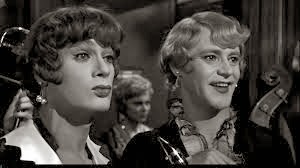
Throughout Hollywood history, there have always been dueling divas. It shouldn't be surprising that such beautiful, talented, hard-working and passionate women might be a tad competitive with one another. Whether on or off screen, many Hollywood women have ambitiously competed to grab their moment in the spotlight. One thinks of examples such as Bette Davis v. Joan Crawford or sisters Olivia de Havilland v. Joan Fontaine. After all, it has always been and continues to be a man's world in tinsel town. But I can think of an exception where a dueling diva duo is challenged by quite the opposite- how to fit in a women's world. I'm speaking of characters Daphne and Josephine in Billy Wilder's SOME LIKE IT HOT (1959).
In Billy Wilder's comedy masterpiece SOME LIKE IT HOT (1959), Joe (portrayed by Tony Curtis) and Jerry (portrayed by Jack Lemmon) are two musicians on their last dime and struggling to find that next gig when they accidentally stumble upon witnessing a mob hit from gangster Spats Colombo (portrayed by George Raft) and his henchmen. They are able to escape the mobsters' clutches by taking their next gig, train-bound for warmer climates of Florida and a paycheck. But there's an interesting caveat. This is a 'women only' band so they must dress up and impersonate as women to join the band. And so they do, out of pure desperation. Thus, Joe and Jerry become Josephine and Daphne.
The screwball fun continues the moment these cross-dressers board the train and meet the other lady musicians. Most notably, fellow gal band member Sugar Kane (portrayed by Marilyn Monroe) catches their eyes immediately. (How on earth could anyone NOT?!) Joe spends the rest of his time trying to woo Sugar Kane as Jerry (and by Jerry I mean Daphne) is being wooed by millionaire Osgood Fielding III (portrayed by Joe E. Brown). In an attempt to impress Sugar Kane, Joe pretends to be a millionaire himself- from speaking in his best Cary Grant stereotype accent to borrowing a yacht. Things are becoming... complicated:

Jerry: Have I got things to tell you!
Joe: What happened?
Jerry: I'm engaged.
Joe: Congratulations. Who's the lucky girl?
Jerry: I am!
 
The tension builds between Joe and Jerry and chaos amplifies when the gangsters show up at the same hotel for a convention as the two try their best to avoid revealing their true identities. In the end, it all works out for both Daphne and Josephine as it does for Jerry and Joe, not to mention Sugar Kane and Osgood... even if in a somewhat unconventional way. 
 What makes this film work so well is the performances and chemistry of these great actors and undoubtedly the talented writing and direction from Billy Wilder. While feuding over differences, characters Jerry and Joe (and as Daphne and Josephine) also reveal what great chemistry the actors Tony Curtis and Jack Lemmon possess. I can only imagine how fun those two actors must've had on the set. To see if their makeup and costuming is convincing as women, Curtis and Lemmon walked into a women's restroom without startled responses. Jack Lemmon and Joe E Brown learned to tango from co-star George Raft. Tony Curtis needed help in getting his voice high-pitched enough to play Josephine so they enlisted co-star Paul Frees (well-known voice talent) to dub with his voice. 
Accounts of Marilyn Monroe's experience on the set suggests something more challenging- from 3 hour starting time delays to 50 takes on a scene, with lines written on cue cards hidden within the set. To be fair regarding her moody behavior, she was pregnant at the time and some publicity stills required cropping with stand-ins. But despite Marilyn's personal issues, the results are still amazing on-screen. Mitzi Gaynor was originally considered for the role of Sugar Kane but I can't imagine anyone but Marilyn Monroe playing this sweet, vulnerable and incredibly sexy role.         

Considerations for the roles of Jerry and Joe were given to Bob Hope, Danny Kaye, Anthony Perkins, Frank Sinatra and Jerry Lewis. Jerry Lewis declined because he refused to dress up as a woman. This is a decision he later regretted after Jack Lemmon earned an Academy Award nomination for his cross-dressing role. Lemmon reminded him by thanking him repeatedly in the years to follow.

Despite its huge success and staying power as a comedy classic, leading men dressing in drag on-screen in 1959 had its share of some controversy. The Roman Catholic Church's Legion of Decency slapped it with a "condemned" rating. And my very own home state of Kansas banned the film entirely stating it was "too disturbing for Kansans." I guess some things never change. Even with a few obstacles, nothing could stop this pair of dueling divas as a hilarious duo that remains forever in my heart as pure comedy gold. 
*This post is my contribution, via taking creative liberties, to the Dueling Divas Blogathon hosted by Lara at BACKLOTS.  There are amazing bloggers who have participated in this feast of a writing topic so be sure to 'do them a solid' of exploring their posts, too! As for me, I'll finish by repeating from Billy Wilder's epitaph... "I'm a writer, but then nobody's perfect."


Saturday, December 21, 2013

Classic Christmas Memories... Rankin/Bass Specials

From 1960 to 2001, Rankin/Bass Productions company made 66 film productions. Animated features and series for television, the Rankin/Bass productions ranged in themes from King Kong to Jackson Five but they are most famous for their Christmas specials. Originally named Videocraft International, the television production company was founded by Arthur Rankin, Jr. and Jules Bass in the early-1960s. Starting with their first series on Pinocchio, this series and many to follow were produced using "Animagic." Made famous by Art Clokey's "GUMBY" and George Pal's "PUPPETOONS," Animagic was a special stop-motion animation process. This technology utilized an articulated metal armature inside the figures was actually pioneered by the famous Ray Harryhausen in Merian C. Cooper/Ernest B. Schoedsack's KING KONG (1933), decades earlier. 

Several of these stop-motion animations were produced as Christmas specials based on popular songs. Here are my favorites:

RUDOLPH THE RED-NOSED REINDEER (1964):
Based on the premise of the song itself, we are introduced the story of Rudolph via a lovable snowman, narrated by Burl Ives who is animated in his likeness. Wearing a green plaid vest, a bowler hat and sporting a Mr. French-like beard, this snowman glides across the snow with ease as he sets the stage for the early years of this uniquely-nosed reindeer. And he does so by treating us with festive song, such as "Silver and Gold."
The song "Rudolph the Red-Nosed Reindeer" was a popular Christmas-time tune ever since Gene Autry's recording in 1947. But Rudolph the character was actually created by a Montgomery Ward employee back in 1939 as part of an advertising campaign. The entire film's soundtrack was recorded in a studio in Toronto, Ontario with the singing and speaking cast being mostly Canadian. The animation was solely filmed in Japan.  

The cast of sweet and quirky characters make this children's feature special. Rudolph himself is the endearing reindeer who tries to mask his unique feature due to pressures to fit in, but proves he's the admirable one through his bravery. Herbie the elf (the only elf without pointed ears and the only one with hair) stands out as the misfit that possesses no toy-making skills but rather a passion for dentistry and a sunny outlook despite not being accepted by his peers. Yukon Cornelius the lovable prospector and his friendly dog sled team are on the hunt for a peppermint mine, not silver and gold as one would assume. Even an Abominable Snowman, nicknamed "Bumbles" by Cornelius, is included the cast of fun characters. I'm convinced most my childhood photos reflect my appreciation for Bumbles' toothy grin (see comparison below). And of course the entire cast of characters on the Island of Misfit Toys find acceptance and ultimately show us that even misfits have a place in society, especially at Christmastime. 
Interestingly, in the original TV launch in 1964 they reference going to the Island of Misfit Toys but there was no conclusion. So after a barrage of letters from fans worried about the fate of the misfit toys, Rankin/Bass added the ending we see today where all the toys find new homes. During first broadcast, Rudolph was released as part of the 'General Electric Fantasy Hour' on NBC and many commercials aired that featured the elves themselves pitching all the latest GE products for Christmas retail sales. You can see them here.  

SANTA CLAUS IS COMING TO TOWN (1970)
When this film originally aired, I was four years old and my baby sister was just born. So I recall this one fondly as my childhood standard to watch every Christmas season with utter delight. This holiday classic enlists a celebrity again to narrate the story. None other than legendary Fred Astaire himself introduces us to Santa Claus aka Kris Kringle by answering all the questions we've always wondered about... where did he come from? .... where did he get that suit? ... where did he get that name? ... why does he give us presents in stockings? ... and so much more. Like Burl Ives as the jolly snowman in RUDOLPH THE RED-NOSED REINDEER (1964), Fred Astaire's likeness is wonderfully replicated in Animagic wonder as the singing (and yes, of course dancing) mailman S.D. Kluger who helps unravel all the riddles of the mysterious Santa mythology. 
And like in RUDOLPH THE RED-NOSED REINDEER (1964), this story takes us on a journey with interesting characters. While Rudolph took a journey with Yukon Cornelius and Herbie, here we follow the adventures of Kris Kringle as he grows up and meets characters like Tanta (voiced by Joan Gardner) and the other bearded and elven Kringles who raise him. Once he becomes a man, we are introduced to Jessica (voiced by Robie Lester and whom my husband has had a 'cartoon crush' on since childhood) aka future Mrs. Claus, Burgermeister Meisterburger (voiced by Paul Frees), and the Winter Warlock (voiced by one of my favorite characters, Keenan Wynn). Santa is voiced by another classic film actor, Mickey Rooney. This film with its songs, characters and stop-motion animation is simple yet charming. It's obvious why it's remained a classic for all ages.

Special Mentions:
THE LITTLE DRUMMER BOY (1968) is another favorite for many. It tells the story of a poor orphan boy who befriends young animals yet is challenged by hatred in his heart and deals with many struggles like poverty and abandonment. But his journey ends to intersect with the birth of Jesus Christ. His gift is pure love and playing his drum for the newborn son of God. The tone is too religious for me personally. But the voice celebrities are great- Greer Garson narrates and Jose Ferrer voices the character of Ben Haramed. It was always the favorite of my mother's and my husband's, as well. The songs are memorable, especially the title song. My favorite version of "The Little Drummer Boy" song was recorded by Bing Crosby and David Bowie in 1977. You can hear it here.
THE YEAR WITHOUT A SANTA CLAUS (1974) is definitely worth adding a special mention. The premise is what happens when Santa is too sick and heart-broken to make his typical Christmas sleigh trip around the world; that is until Mrs. Claus and the North Pole gang convince him otherwise. Mickey Rooney returns as Kris Kringle and Shirley Booth lends her voice talent as her last film appearance. But my favorite segment of this film by far is Mother Nature's sparring sons, Snow Miser (voiced by Dick Shawn- you can read more about another hilarious film performance by him here) and Heat Miser. These characters are uniquely fun. Frankly I wish these two had an entire film devoted just to their musical numbers. See if you agree, by checking out their bit here.
While there are many other Rankin/Bass features you may prefer to include on your list of favorites, these are my picks from my childhood memories. A consistent theme you see in these holiday specials are the positive messages of hope, kindness and friendship. As Clarence the angel wisely gifted to his new pal George Bailey in my favorite holiday film, Frank Capra's IT'S A WONDERFUL LIFE (1946)... "no man is a failure who has friends." I couldn't agree more, Clarence.

*This tribute to my top Rankin/Bass holiday specials is my contribution to the Christmas Movie Blogathon, hosted by Family Friendly Reviews. Be sure to check out the other bloggers' contributions to their favorite Christmas-themed classics, too. Merry Christmas and a very Happy New Year!!    
    

Wednesday, December 4, 2013

CMBA Film Passion Blogathon: IT'S A MAD, MAD, MAD, MAD WORLD

Growing up as a kid, classic comedies were a shaping influence in my life. My earliest memories of classic film derives from the comedies I watched with my family. I recall my grandmother and my uncle Patrick introducing me to comedy classics like Marx Brothers films, the Pink Panther films, Blake Edwards' THE GREAT RACE (1965), George Cukor's THE PHILADELPHIA STORY (1940) and countless screwball comedies. And whenever life hits those bumps in the road, I've always sought comfort in a small handful of films guaranteed to cheer me up so I can escape into laughter.  One of my favorites on this list of chuckle-inspiring classics is Stanley Kramer's IT'S A MAD, MAD, MAD WORLD (1963).
It seems fitting to write about this hilarious classic at this particular time to honor the recent passing of IAMMMMW co-star Jonathan Winters. It's also timely with this past year's (also in April 2013) Turner Classic Movie Film Festival's debut screening of IAMMMMW for its 50th anniversary celebration, at Pacific Theater's famed Cinerama Dome. Fifty years ago the Cinerama Dome, the world's only concrete geodesic domed structure, kicked off their grand opening with this film's premiere as the world's first new 70mm single strip projected on the Cinerama curved screen, to mimic the effect of the three-strip Cinerama processed movie.

IT'S A MAD, MAD, MAD, MAD WORLD (1963) is a fast-paced, action-packed race brimming with cameos of laughter legends and a large cast of comedy greats. This cinematic roller-coaster ride of an adventure starts with a speeding car recklessly careening in between cars down the twists and turns of a California highway.  [By the way, you may likely experience SPOILERS along this bumpy ride, so buckle up buttercup!] Soon, this car loses control and goes flying off the road, crashing into the rocky desert canyon below. Witnesses of nearby drivers immediately pull over and rush to the wreck below.
Legend Jimmy Durante plays the role of Smiler Grogan, the man who has been thrown from the car. The immediate ensemble of drivers that rush to aid crash-victim Grogan are: J Russell Finch (Milton Berle), Melville Crump (Sid Caesar), Ding Bell (Mickey Rooney), Benjy Benjamin (Buddy Hackett) and Lennie Pike (Jonathan Winters). Grogan proceeds to share his deepest secret in his last dying words- there are "350 G's buried under a big W in Santa Rosita park." He says that he earned every penny but it's there for the taking. Norman Fell portrays the police detective who arrives immediately on the scene after Grogan literally 'kicks the bucket.'
The group of witnesses reveals nothing to the detective of the confessed crime of buried loot moments prior. Instead, they get back into their cars and head back on the road, but shortly pull over to discuss this incredible discovery. Sid Caesar's Crump is joined by wife Monica (Edie Adams) in their vehicle. Rooney's Bell is riding along with Hackett's Benjamin. Berle's Finch has the hilarious misfortune of being joined by his wife Emeline Marcus-Finch (Dorothy Provine) and his bossy and 'in your face' mother-in-law, Mrs. Marcus (Ethel Merman) in their vehicle. [You might recognize Provine as the entertaining 'native of Burracho' singer Lily Olay in THE GREAT RACE (1965).] And delivery driver Lennie Pike (Jonathan Winters) rides solo in his truck. Even though no one can figure out what or where exactly this 'big W' is, and after several arguments of how best to divvy up the treasure; they soon realize that the best approach is not to share it at all. It's every man and woman for themselves. They dash to their vehicles, speeding away and the madcap race begins.
Meanwhile back at the police station in Santa Rosita, Capt. Culpepper (portrayed by Spencer Tracy) is convinced that these drivers, who were spotted roadside by officers conversing together, know more about the missing stolen money than they led on. He instructs patrol officers to keep tabs on the group, but at a safe distance, in hopes they'll lead them to the secretly stashed treasure. He confers with Police Chief Aloysius (William Demarest) that all his troubles will come to an end if he could only close this case after all these years and take his impending retirement with pride and a proper pension. We soon discover that his constantly critical wife Ginger (voiced by Selma Diamond) and needy daughter Billie Sue (voiced by Louise Glenn) are the true sources of all his unhappy troubles.
In desperation, each of the vehicles attempts the quickest routes to Santa Rosita before any of the other drivers beat them to the chase. The Crumps charter an ancient broken-down biplane. The Finch trio are accidentally rear-ended by Pike's truck so they separate and deceptively leave Pike behind with no transportation other than a kids' bike. The Finches are soon picked up by "Colonel" J. Algernon Hawthorne (Terry-Thomas). Pike shares his fascinating story and a promised portion of the findings to passerby Otto Meyer (Phil Silvers) in exchange for a ride to Santa Rosita. But Meyer immediately tricks Pike and leaves him and his damaged little girly bike behind on the deserted road. Like karma-come-calling, Meyer soon gets a flat tire and drives to a brand-new garage station down the roadway to repair and gas up. By now, Pike is completely fueled by rage as he awkwardly rides up to the garage station and proceeds to attack Meyer. In the chaos of the moment, Meyer convinces the garage attendants (Ray- Arnold Stang, Irwin- Marvin Kaplan) that Pike is actually a homicidal maniac escaped from an asylum and they should subdue him until police arrive. Meyer escapes. Pike then breaks free but then completely annihilates the brand-new garage station in a hilarious fight scene between Winters, Kaplan and Strang.
Meanwhile, The Finch foursome abruptly take a change of course when mom-in-law Mrs. Marcus attempts to call on her son and beach bum Sylvester (Dick Shawn) to help them out since he lives so close to their destination. And the duo of Benjamin and Bell (Hackett and Rooney) do their best to waken an excessively hungover pilot Tyler Fitzgerald (perfectly portrayed by Jim Backus) at another local airport to hasten their pace in this race. After copious coffees and showering, they coerce Fitzgerald to fly them to Santa Rosita. Unfortunately, pilot Fitzgerald wasn't quite done with his bender so he asks Benjamin to hold on to the wheel while he pours himself an old-fashioned. As fate would have it, the pilot is knocked out cold when the plane takes a sudden dive with the inexperienced Benjy at the yoke of the cockpit. Now they're forced to engage in a chaotic frenzy to land the plane themselves at Rancho Conejo, with the assistance of the tower traffic control team (Eddie Ryder, Jesse White, Paul Ford and Carl Reiner).
While the Crumps barely made their landing, they stop by Dinckler's hardware store to get digging tools. But as luck would have it, Mr. Dinckler (Edward Everett Horton) accidentally locks them in the basement. A series of crazy misfortunes ensue as they attempt to escape from their capture with everything from a forklift to dynamite to fireworks. The Finches splinter off after Russell and Colonel Hawthorne go off on their own in disagreement regarding the merits of pursuing Sylvester. Emeline Finch and mom-in-law rejoin with Pike, despite the abuse he endures from Mrs. Marcus. Sylvester doesn't pay attention to his mother's directions so he hectically drives to meet them- in the opposite direction, instead.  After explosions, near-death amateur plane landings, car wrecks and fighting, all the various treasure-seekers along with Capt. Culpepper not far behind finally head towards the park in Santa Rosita.
WHEW! Are you staying with me so far?! Each sub-group appears at the Santa Rosita state park- some arrive in taxis driven by cabbies Peter Falk and Eddie 'Rochester' Anderson who catch on that there's something fishy going on. At first, each frantic treasure hunter runs around the park with picks and shovels in hand and no clue to the whereabouts of the 'big W' (although the audience has discovered by now). Emeline Finch wants no part of this from the very beginning as she sees this as an unethical pursuit, so she stays behind by the water fountain to cool herself when she looks up and makes the startling discovery of the big W. Capt. Culpepper is close by when he observes her response. Without revealing his identity, Culpepper approaches and she blurts out her amazing discovery, revealing a change of heart that perhaps she could enjoy the riches after all; to seek a life of solitude as an escape from her family. Meanwhile, everyone else has agreed it's silly not to come together as a group, just as Pike makes the discovery of the 'BIG W'!

Culpepper is on hand to finally introduce himself in timely fashion as the entire group huddles over the buried treasure, after taking turns in digging. Culpepper then tells the lot that perhaps the courts would look upon them more favorably if they turned themselves in, instead of the police bringing them in. He takes the money and gets in his car. But as the group senses something is odd with Culpepper's handling of the situation, they cumulatively pull over in the taxis (not allowed to take any other cars because they were all illegally gained) to discuss. They decide to follow Culpepper who turns out is not heading back to the police station at all. They continue pursuit as Culpepper rapidly heads south towards Mexico to escape with all the money for himself. By now, the other police have caught on to Culpepper's deception. The Chief of Police Aloysius attempts to talk Culpepper out of his newly found criminal ways via the car radio, by stating he's been in conversation with the mayor to discuss his pension. But it's too late for Culpepper to turn back now. He's gone too far into the madness of this mad, mad, mad, mad world.
The chase wraps up in a crazy madcap scene, in the backdrop of a condemned multi-story building ready for demolition. In the final scene, classic comedic justice is served up. We see all the men in a prison hospital ward in rows of beds as they're moaning and complaining from multiple injuries and broken bones in full body casts- each casting blame for their sad predicament. Culpepper admits his guilt with a heavy heart, feeling sorry for himself. The women, in prison gowns, march in to give the men a verbal thrashing. Just as mom-in-law Marcus leads the charge, she slips on a banana peel on the floor and falls in a classic comedy pratt fall- the uproarious laughter results. All the men are laughing so hard they're swinging in their elevated slings and body casts.

In addition to this AMAZING cast, this film is peppered with recognizable character actors and cameos from some of the best comedy stars ever assembled in a single movie. Here is a LOOOONG list of the cast:
Spencer Tracy - Capt. TG Culpepper
Milton Berle - J Russell Finch
Sid Caesar - Melville Crump
Buddy Hackett - Benjy Benjamin
Ethel Merman - Mrs. Marcus
Mickey Rooney - Ding Bell
Dick Shawn - Sylvester Marcus
Phil Silvers - Otto Meyer
Terry-Thomas - J Algernon Hawthorne
Jonathan Winters - Lennie Pike
Edie Adams - Monica Crump
Dorothy Provine - Emeline Marcus-Finch
Eddie 'Rochester' Anderson - 2nd cab driver
Jim Backus - Tyler Fitzgerald
Ben Blue - biplane pilot
Joe E Brown - union official
Alan Carney - police sergeant
Chick Chandler - detective outside Chinese laundromat
Barrie Chase - Sylvester's girlfriend
Lloyd Corrigan - the mayor
William Demarest - Police Chief Aloysius
Andy Devine - Sheriff of Crocket County
Selma Diamond - Ginger Culpepper (voice)
Peter Falk - 3rd cab driver
Norman Fell - detective at Grogan's crash site
Paul Ford - Col. Wilberforce
Stan Freberg - Deputy Sheriff
Louise Glenn - Billie Sue Culpepper (voice)
Leo Gorcey - 1st cab driver
Sterling Holloway - Fire Chief
Marvin Kaplan - Irwin
Edward Everett Horton - Mr. Dinckler
Buster Keaton - Jimmy, the crook
Don Knotts - nervous motorist
Charles Lane - airport manager
Mike Mazurki - miner
Charles McGraw - Lt. Matthews
Cliff Norton - reporter
Zazu Pitts - Gertie, switchboard operator
Carl Reiner - tower controller at Rancho Conejo
Madlyn Rhue - sect. Schwartz 
Roy Roberts - policeman outside Irwin & Ray's Garage
Arnold Stang - Ray
Nick Stewart - migrant truck driver
The Three Stooges (Joe DeRita, Larry Fine, Moe Howard) - firemen
Sammee Tong - Chinese laundryman
Jesse White - radio tower operator at Rancho Conejo
Jimmy Durante - Smiler Grogan
Jack Benny - man in car, in desert
Wally Brown - policeman
Stanley Clements - detective in squad room
Allen Jenkins - cop
Robert Karnes - Officer Simmy
Tom Kennedy - traffic cop
Harry Lauter - police dispatcher
Bobo Lewis - pilot's wife
Jerry Lewis - driver (who runs over Culpepper's hat)
Eddie Ryder - air traffic control tower staffer
Doodles Weaver - hardware store clerk 

See what I mean? As long as this film's list of hilarious characters' is, the actual running time of this film depends upon which version you've experienced. The original cut was 210 minutes long. Then Stanley Kramer edited the premiere cut to 192 minutes long. But due to it's overwhelming popularity during it's 70mm roadshow to squeeze in an extra daily showtime, United Artists (without any direction from Kramer) cut it down to 161 minutes. But more than likely, you've seen the 35mm general release which has a running time of 154 minutes (minus overture and exit music.) Various attempts have been made over the years to restore missing content from the original 70mm and theatrical release formats to its original version. Most recently, Criterion has announced the release of a special edition 5 disc Blu-ray/DVD with restored audio and visual road-show elements from acclaimed film preservationist Robert A. Harris for January 21st, 2014! (Adding this to my holiday wish list... http://www.criterion.com/films/28579-it-s-a-mad-mad-mad-mad-world )

Stanley Kramer's original intent was to assemble as many comedy greats as possible- for a round-up tribute of the who's who in legendary comedy. Stanley Laurel was invited but declined because he kept true to his promise to never appear in film again after the death of his beloved partner, Oliver Hardy's death in 1957. Some declined outright like Bob Hope, George Burns, Red Skelton, and Judy Holliday (Holliday declined due to poor health.) And some felt offended that they were not invited at all, like Don Rickles; who openly ribbed Kramer as a result, whenever he attended one of his shows. 

Filming such action-packed, physical scenes took a toll on the cast. Phil Silvers was injured twice during the gas station scene by Jonathan Winters. He also claimed near-drowning during the scene of the car in the river (he couldn't swim.) Arnold Stang suffered a broken arm right before shooting the gas station destruction scenes so they made special accommodations with his wardrobe to disguise his sling. Milton Berle claimed he suffered bruising for months after being on the opposite end of Ethel Merman's handbag in a scene. (Interestingly, Milton Berle plays Ethel Merman's son-in-law, yet in real life was only 6 months younger in age.) Spencer Tracy was already in poor health by filming (emphysema and diabetes) so Kramer ensured he only worked a total of nine days, at only a few hours a day, and with no scenes shot in the extreme dry heat of the desert. Stunt doubles were used whenever necessary.
Personally, my favorite performances come from Ethel Merman, Dick Shawn and Jim Backus. Such hilarious characters! Ethel Merman's role was originally supposed to be a father-in-law portrayed by none other than Groucho Marx. As much as I would have loved seeing Groucho in this film, Merman's brazen performances and funny lines really drive this story. Shawn's screen presence of over-the-top craziness is solid entertainment. And Jim Backus is perfectly suited as the marathon-drinking pilot. He delivers one of my favorite lines during a flying scene as pilot Fitzgerald- in a way that only Jim Backus can deliver, as he tells Benjy to take over as substitute flyboy and as he mixes himself a drink:
Benjy Benjamin: "What if something happens?'
Tyler Fitzgerald: "What could happen to an Old Fashioned?!"

This overly long and mad, mad, mad, mad perspective is my contribution to the CMBA Passion 101 Blogathon. Be sure to enjoy all of the other CMBA bloggers' contributions, because they are likely talented beyond compare. This is also my personal homage to my family members who lovingly introduced me IT'S A MAD, MAD, MAD, MAD WORLD (1963) and all the classic comedians that this film features, which led to my life-long love of classic comedies. They also taught me life's greatest lesson: no matter how maddening life's challenges become, it can be overcome with the gift of laughter.